












































How Zoho Creator for Healthcare Organizes Patient Records Without Slowing The Process
Patient record management rarely fails overnight. More often, it becomes harder to manage as teams grow, systems multiply, and responsibilities overlap. Information starts getting spread across different places. Gradually, teams notice that updates move more slowly than they should. Your staff starts relying on informal fixes just to keep things moving.
For healthcare organizations, the issue is not about technology, but operations. When patient data isn’t structured around how teams actually work, even capable systems stumble on problems. Healthcare managers need not add more software to their systems. What they need is clarity, consistency, and control over patient records.
This is where platforms like Zoho Creator prove to be an effective solution.
Why Patient Record Management Becomes an Operational Problem
As the number of patients increases, even small inefficiencies start to compound. Here are some common hurdles:
- Intake forms are filled manually
- Updates take time to reach the right person
- Information is duplicated or missed altogether
However, none of this shows up as a single failure, but it affects response times and ultimately the experience of patients.
Low-Code Systems That Adjust to Healthcare Workflows
Healthcare workflows vary widely between clinics, hospitals, diagnostic centers, and specialty practices. That’s why rigid systems often struggle once operations scale or change. This is where healthcare managers want to know how low-code platforms for healthcare providers are useful in practice.
Instead of forcing teams to change how they work, low-code systems allow internal tools to be shaped around existing processes. Forms, approvals, record views, and alerts can be adjusted as care models evolve, and there are no lengthy development cycles. It’s less about speed and more about control.
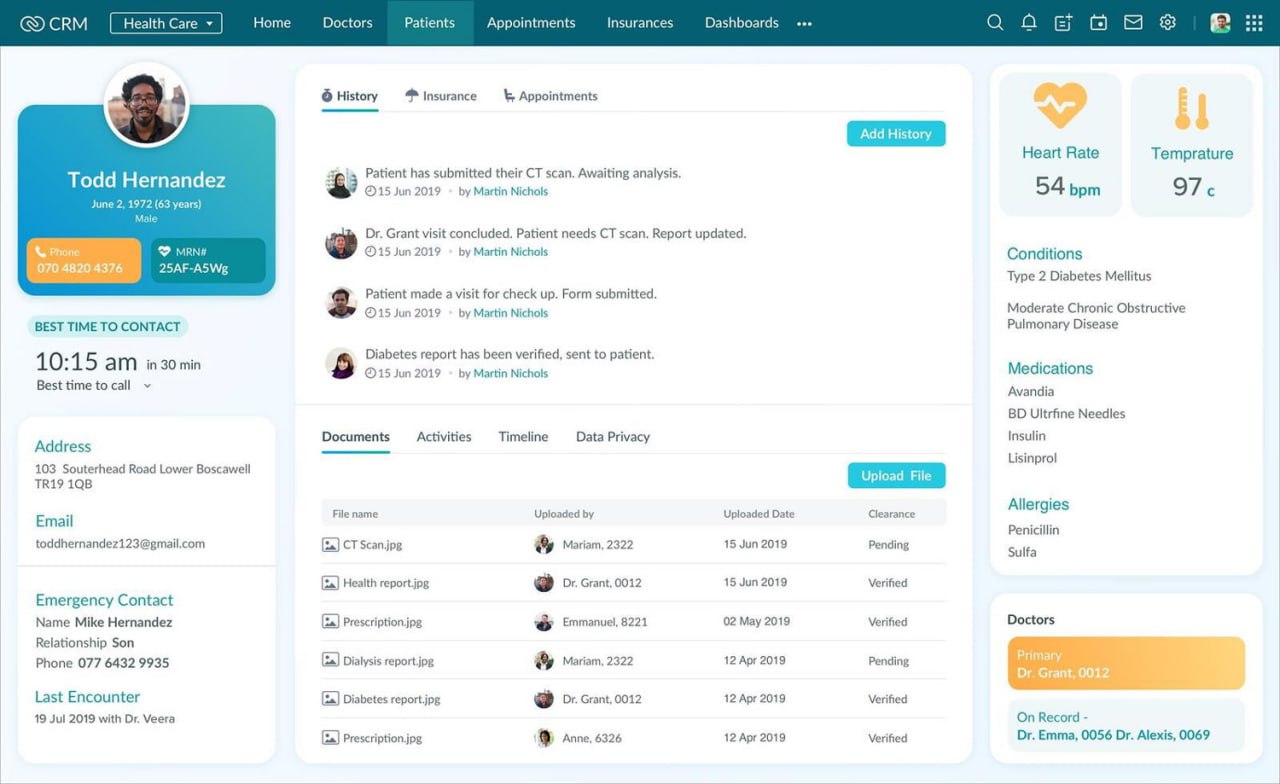
Centralization only helps when it reduces effort, not when it adds another place to check. When patient information like demographics, visit notes, diagnostics, and follow-ups comes together in a single structured view, teams need not wait for updates.
Security Reflects Real Responsibilities
Access to patient data isn’t uniform, and systems shouldn’t treat it that way. Different roles require different levels of visibility. Front-desk staff don’t need clinical notes. Clinicians don’t need billing workflows. Teams using Zoho for healthcare can support role-based access, audit trails, and controlled permissions. This allows them to share information without overexposing it. Security becomes part of daily operations.
Forms Match Clinical Use
Generic forms are one of the quietest factors leading to inefficiency. They collect too much information, miss what matters, or force manual corrections later.
Custom forms that can record actual clinical and administrative information reduce confusion and improve data quality at the source. When information is captured the first time correctly, everything downstream becomes easier.
Working Along with Existing Systems
Today, very few healthcare organizations are starting from scratch. Even in your organization, scheduling tools, billing systems, and EHRs already exist. The practical requirement is integration, not replacement.
When appointment data triggers record updates automatically, or billing information moves from completed visits without manual intervention, your team will be spending less time coordinating and more time delivering care.
Scaling Without Rebuilding
Growth shouldn’t force reinvention. As patient volumes increase or services expand, record systems need to scale without disrupting daily operations.
Incremental changes, like new forms, updated workflows, and additional access controls, allow teams to adapt without losing continuity. That stability matters more than speed in healthcare environments.
Why Choose Xponential Digital
Xponential Digital works as a specialized Zoho partner with healthcare teams to design systems that fit real operational patterns. These experts prioritize proper governance and long-term usability, which goes much beyond surface-level automation. They align tools to how teams actually work, helping them organize patient records without disrupting the delivery of healthcare. If you’re struggling with patient record management, consult the professionals to integrate Zoho.







 Xponential Digital